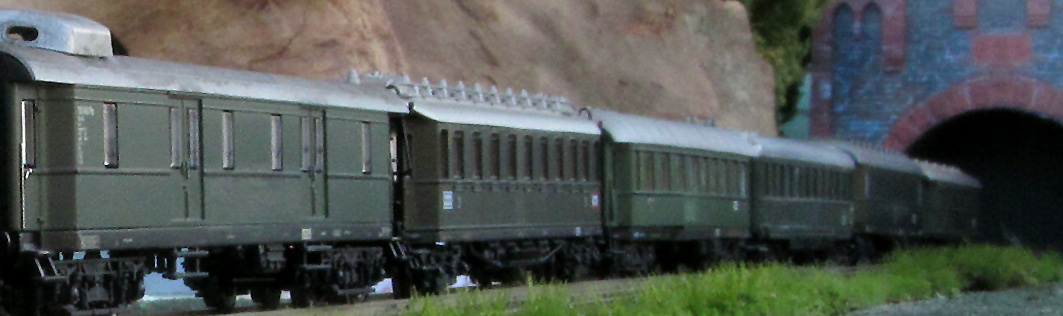
Deutsche Bundesbahn express coaching stock and trains formation from 1949 to 1954.
With less motor cars over the roads and aircrafts in the sky than today, travelling in early 1950s
meant to take a train (sometime even a ship). Rythms of daily life were significantly different from
nowadays, time measured in a slower way, and so was the journey. Soon after World War II travel
by train in Europe was even longer than before, since many lines and infrastructures were in poor
conditions; in most cases trains ran alternately one way, or by alternative routes, while rails were
repaired or replaced. If you take a look at a DB timetable you’ll see that in 1949 for working a 100 km
line, a steam hauled local needed more than 3 hours; a Dortmund to Frankfurt trip (226 km) was
5 hours and 45 minutes for the faster train, more than seven hours for an ordinary Express.
Until recent past, with definition “Express train” in Germany we could group three different ways
of travel: with Fernschnellzug (commonly F-zug), Schnellzug (commonly D-zug) or Eilzug.
The firsts were fast long distance trains (even international) formed with the most prestigious
available carriages, with a maximum speed of 120 km/h and few stop along the route; we could say they
were the ancestors of TEE and Intercity. D-zug was the classic express train, usually without first
class seats (except when international) and a speed up to 100 km/h.
Eilzüge were their stopping and shorter-distance version. Sometime an Eilzug was a D-zug only
for a route portion. In the same way an Eilzug could became a local for the initial or final route portion.
Through the years the busiest Eilzüge would became D-züge, rationalizing itinerary and strengthening
their formation; viceversa a D-zug could have been declassed to Eilzug.
Just one word to mention Special trains (Sonderzüge), not included in timetables, but a relevant part of
passengers traffic, especially during summer season, winter holidays and sport happenings.
The coaching stock in Hour Zero.
It’s very complex to examine situation of German carriages stock in the confusion of “Stunde null”,
when the whole country was a big construction site. War destructions, partition with USSR Zone
(shortly thereafter DR) and war damage penalties, reduced pre-war stock of almost 60%.
In those days Bundesbahndirektionen workshops were in hard labour for reparations, transformations
and scrapping of both motive power and carriages; numbers were day after day in constant change.
We know from previous studies that ¾ of carriage stock inherited was for local or short distance traffic.
So, on an amount of 22-23.000 coaches as documents reported, barely a quarter was suitable for long
distance and faster trains. We can suppose not without a certain caution that long distance bogie coaches
were in a number between 5.500 and 6.000 units including baggage cars. On the other side we have the
reliability of first Bundesbahn Zugbildungspläne (Working Notice for trains formation): in about 1000 daily
Expresses only 160-170 of them were worked by Diesel or electric multiple units, especially for F-züge and
Eilzüge, but all others needed at least 5500 carriages in working order, excluding eventual Post, DSG, CIWL
and foreigner coaches.
More than 25-30% of those stock was of Länderbahn origin, mainly Prussian, mainly with a wooden body,
and the rest was of DRG designs, built from 1922 to 1944.
A great number of ex-Länderbahn carriages were used for their frames for building new short distance
3 and 4 axles coaches, for so called Umbauwagen (Re-built cars); delivery began in 1954 for 3 axles coaches
and 1956 for 4 axles.
DRG-built express carriages, including baggage cars, are supposed to be not less than 2000 units, divided
as follows: Hechte (pike) 1923-26 riveted coaches at 10%; late 1920s Lloyd design at 20%; all steel 1936
design at 45%; skirted pre-war design at 15% and other minor series at 10%.
In terms of modernity, prestige and comfort skirted coaches (4ü-38) were the best available.
Bogies baggage vans were signed as Pw4ü, Pw4i and PwPost4ü; their massive production by
Prussian Railways (K.P.E.V.) and DRG allowed to have a quite important fleet: according with Bi-zone
official documents of 1947 they counted more than 600 units. We have to add 236 austerity bogie vans
MC4i-50 (Behelfsgepäckwagen) built in 1950, using for each unit two wooden war coaches
MCi-43 (Behelfspersonenwagen).
The german word Behelf means makeshift.
But the real backbone of Bundesbahn bogie carriages stock was the circa 2000 units fleet of mid-distance
coaches with double doors called Eilzugwagen (4i), built from 1930 to 1936 in 2nd/3rd and 3rd class, and
a skirted variant during war years. Many of these coaches were equipped with upholstered seats and
a more suitable arrangement for higher speed. As we can see from old photos Eilzugwagen were a
constant presence in D-züge, Eilzüge and Sonderzüge of those years; in summer period they could have
been seen from Denmark to italian beaches.
To organize and handle services like dining and sleeping a new subject was created from division
of old Mitropa company: the Deutsche Schlafwagen und Speisewagen Gesellschaft (DSG).
DSG received 238 Restaurant coaches, but this number soon increased for transformation in 1950-51
of 70 old Prussian C4ü and 40 C4i from simple passengers coaches to half restaurant two-saloons.
Moreover, in the same years 44 coaches of various designs were converted in Gesellschaftswagen (WG),
or “Partywagen”, open coaches to be used even on special trains (Sonderzüge) for dining or dancing
purposes (12 were with kitchen). Gesellschaftswagen group was formed by five ex Rheingold Salons of
1928, two C4ü-36, 6 Salons ex Wermacht of 1938 , one baggage car of 1937, three Hechte coaches, two
skirted 1942 coaches, twenty-four ex 4i-36 Eilzug coaches and one MC4i-44 (an austerity wooden war series)
who was painted in silver and used as “Rollende weinkeller”, a kind of rolling tavern not so
different to the one made by Bulleid Southern/British Railway a couple of years before.
Not so reliable was the number of sleeping cars registered to DSG. Anyway not less than 250 units,
although many of them were old ex-Länderbahn carriages near to withdrawal.
Even in this case, for increasing request, a relevant number of C4i Eilzugwagen was modified as Couchettes
and 3rd class Sleepers.
After few prototypes for trial (even six two-floors coaches), the direction for new building designs was a
26,4 metres long open carriage with central doors that will be delivered from 1951 to 1955 in 750 units,
35 of which with kitchen.
With the same concept in 1952 DB started production of the first 88 Couchettes blue coaches
for touristic trains of Touropa Travels Büro. This was the dawn of Wirtschaftswunder.
These series would be followed two years later by further variants built in hundreds of units who will make
history of continental railways, but their relevance in service is out of the period covered here.
Well, summarizing with an example, if we had to represent all the stock of early 1950s in an only one
ten-coaches train, it would have been as follows:
one Pw4ü, three 4ü ex-DRG, one 4ü ex-Länderbahn, three 4i ex-DRG, one DSG carriage and one newly
built.
Except new coaches, painted in Chromoxydium green, Gesellschaftwagen and DSG coaches painted
in red, latter with yellow lining, all the stock was in DRG bottle green (flaschengrün); carriages employed
in home F-trains were painted in blue from 1952.
We have not to forget more than 200 C.I.W.L. both Restaurant and Sleeping cars that daily crossed
West Germany’s rails with more or less renowned international trains.
C.I.W.L.’s Voiture Lits in early DB trains were those of series S, Z (both 1920s vintage) and Y, this last built
from 1930s to 1950s, the last series before the longer modern designs: type P delivery began in 1955.
It worths a mention the presence of an all blue ex-Pullman Restaurant in Rheingold Expreβ,
the only Pullman carriage in official timetable working in Germany from 1950s to the present day
(in the second part of decade it will run in Touropa holiday trains).
Formation of Locomotive-hauled Express trains.
From late 1940s and early 1950s trains were formed by very etherogeneous material: could happen
to see an old Prussian Baggage car followed by a Skirted coach, then two Hechte, and so on.
It was possible even to see one of 60 bavarian bogie coaches refurbished in 1930 or a six axles teak
Prussian restaurant at the end of their career.
Motive power too was not always the excellence: how many express hauled by a BR 50, a P8 or a BR 41
we can see on Bellingrodt pictures…
Apart home-travelling F-züge, made of one or two (rarely more) B4ü coaches plus DSG Restaurant,
with blocked formation, long distance trains of early 1950s had a great quantity of through coaches
(Kurswagen): the train could receive or leave coaches in some station during its long journey.
For istance in a twelve coaches train from Hamburg to München, of the seven coaches travelling the
whole route someone could have started its journey from a previous place, some other had Rome or
Innsbruck as final destination. Of the other five, one or more were detached in Hannover or Würzburg,
one or more were attached in Hannover or Nürnberg, or another city along the line.
Dining car as well was detached out of eating times and Sleeping cars too were detached in the morning
for cleaning and maintenance.
It was not common to find 1st , 2nd or 1st/2nd class carriages in D-züge; all of those available were intended
for F-züge service and painted in blue, with more than 100 coaches in daily service (together with fast
diesel trains). Instead it was frequent there was a 1st/2nd/3rd class (25% of carriage stock) mainly
in international trains.
D-züge had in formation almost always 2nd/3rd and 3rd class coaches in proportion of 40% : 60%.
Types C4ü-36, C4i-30 and 36 were the most numerous with hundreds of units each group.
One or more coaches of a foreigner Railway company (usually one 1st/2nd/3rd or one 1st/2nd and a 3rd)
could have been present, together with a C.I.W.L. restaurant or sleeping cars; in any case they were
through coaches.
A DSG full Restaurant car was present only in F-züge and less frequently in long distance home D-züge,
(international trains had C.I.W.L. material); usually in home D-züge were used half restaurant carriages
or one of 37 baggage cars with a small kitchen installed in early 1930s (as documented: Pw4ük and Pw4ik
were employed on the lines München-Freilassing-Berchtesgaden, Frankfurt-Stuttgart, Köln-Koblenz in
Eilzüge; Köln-Norddeich and Frankfurt-Bremen in D-züge).
Statistically 20% of D-züge had no dining service.
One or more DSG sleeping cars are present in night trains. In case of international expresses we could
have C.I.W.L. Wagon-lits in 1st/2nd class and DSG Schlafwagen in 3rd or 1st/2nd.
In any formation, excluding home blue F-züge, we may have had Post carriages or Post wagons, usually
through coaches that travelled at extremity of the train and sometimes detached/replaced together
with engine. At night conversely it could happen that a few passenger coaches stayed among a major
number of through Post carriages and goods wagons for milk, fish and newspapers night expresses.
Occupation Troops traffic (Besatzungsverkehrs) in early 1950s was worked in different ways:
-full army trains, not for civil transport, called DUS for American troops and DBA for british troops;
-one or more Army carriages as through coaches in an ordinary Express;
-one or more compartments in civil carriages (e.g. 1st and 2nd class in a 1/2/3 classes coach).
In 1952 DUS and DBA Express trains were about a thirty couples and travelled the whole country linking
the several Army bases in West Germany, Hamburg, North Sea ports or West Berlin.
For this duties carriages of almost all types were employed, recognizable with yellow stripes, USTC
(United States Transport Corps) or RCT (Royal Corps Transport) insignia along carriages body or simply
with white destination boards with the writing “Nur für Besatzung – Occupation traffic only – Réservé
aux ressortissants alliés” barred by a red stripe.
Night trains had a lot of sleepers, both C.I.W.L. and DSG; daily trains usually counted more
than a Dining car, could be C.I.W.L. or DSG Restaurants, Buffet cars or Salon cars with kitchen (SB4ük).
In 1951 for Occupation troops we can count near 200 passenger carriages in the three classes,
100 Sleeping cars, 80 Baggages cars (excluding Post carriages and wagons) and at least 50 Dining cars.
Under my eyes I have seven black and white pictures by Carl Bellingrodt of E 719 Frankfurt-Dortmund.
The one shot in Bacharach is fabulous. Three are dated 1951, two 1952 and one is 1953. They are all
different both for motive power and rolling stock formation. In no image no one can see what it should
be according to the ZpA! Why? The reasons are the most varied, or, if you prefer are always the same:
maintenance, a fault, more travelers, less travelers, and so on.
An advice, or better a tip for all modellers: don’t take ZpAs too meticulously, there’s no need to be too
finicky with trains formations.
Fonts: Carl Bellingrodt, DB Amtliches Kursbuch 1949, DB ZpA 1950/51 and 1952/53, Joachim
Deppmeyer, Wolfgang Diener, EK Verlag, Friedhelm Ernst, Michael Meinhold, Horst J. Obermayer,
Wolfgang Scharf.
©Clive Thomas 2020